Jawad Elatab v Hesperios, 19 cv 9678 (ALC) (SDNY June 2, 2021)

I mean in the case. Of course it’s fair use here.

Defendant clothing company published plaintiff’s photo (left, above) of Bella Hadid, on its Instagram account with the caption:  “@Bellahadid in our Lou tank and Lou Bel skirt knit set in fawn brown (right, above). Coming soon for Fall, although available now in summer colours. .  .” Plaintiff sues for copyright infringement. Defendant moves to dismiss alleging fair use.

Noting that it is difficult for a defendant to establish the affirmative defense of fair use at the motion to dismiss stage (given that the defendant can only work with the facts contained in plaintiff’s complaint), but also noting that its not impossible to prevail at that state (given that the court could possibly determine that use was fair by merely looking at plaintiff’s work and defendant’s complained-of reproduction, as you can do in the side-by-side above (See what I did there?).

The court then proceeds to evaluate fair use:

  1. Nature of use: The posting of the photo did not alter the original message of the photo. There is no modification – nor invitation to defendant’s IG followers to provide commentary. “defendant has failed to demonstrate that its post was anything other than commercial use to advertise its clothing.”
  2. Nature of the work: The photo was a typical creative work entitled to (c) protection. No discussion in the decision where the photo was published if ever.
  3. Amount and substantiality used: Defendant argued it needed to copy the entire work to invite its members to comment – however there was no such invitation – merely an advertisement for the clothes.
  4. Potential Effect of the Use on the Market or Value: Defendants posting invades plaintiff’s statutory right to license.

So is it possible to reproduce a photo of a celebrity wearing your company’s clothes?

Text of Elatab v Hesperios fair use decision

Etsy/DePop

Coupang:

Mercado Libre:

Sure Fit Home Products v. Maytex Mills, 21 Civ. 2169 (LGS) (SDNY <ay 26, 2021)

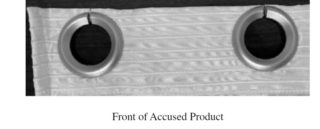
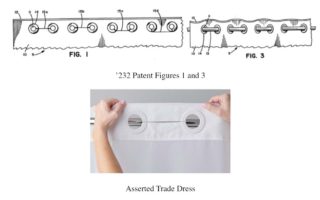
Plaintiff and defendant make shower curtains. Plaintiff owns utility patents that allow shower curtains to be installed on a rod while the rod is fixed in place. This magic is accomplished by placing holes hear the edge of the curtain, with a horizontal slit between holes. Voila:


Plaintiff also obtained a design patent. Its new, original, and ornamental design looks like this:


Plaintiff also claims trade dress, comprised of:

a shower curtain wherein the curtain lacks any hooks protruding above the upper edge of the curtain, so that Plaintiffs’ shower curtain provides the visual appearance of an essentially “neat” and “orderly” upper edge;

 and wherein the shower curtain has a row of rings along the upper portion of the shower curtain, those rings being attached to the material of the shower curtain such that the bottom surface of each ring (on one or both sides of the shower curtain) is essentially co planar with the material of the shower curtain, also providing an essentially “neat” and “orderly” appearance;
wherein each ring includes a slit or gap in the ring;
and wherein the shower curtain’s rings or pairs of rings, and the associated slits or gaps, are each fixed in place on the shower curtain and provide an organized and symmetrical repeating visual pattern along the top width of the shower curtain.
Plaintiff sells its curtains under the HOOKLESS trademark (registration obtained under 2(f)).
Defendant sells competitive shower curtains. Plaintiff alleges design patent and trade dress infringement, and moves for a preliminary injunction.
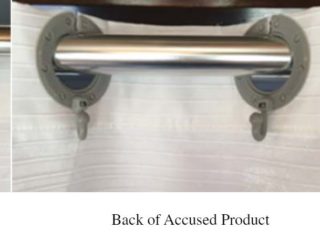
As to the design patent, the court noted that defendant’s curtains look like this:
The court then consulted the Egyptian Goddess of Design Patents (543 F.3d 665 (Fed Cir 2008), noted the bevels and hooks on defendant’s rings, and held that plainitff had not shown that it was likely to prevail.
Turning to plaintiff’s unregistered trade dress (which has no presumption of protectability), the court noted the similarity between plaintiff’s utility patent and its description of the trade dress.
Because of the overlap in features between the utility patent and the claim trade dress, the plaintiff failed to meet its burden of establishing non-functionaltiy (and therefore the court does not need to address whether the claimed trade dress had achieved distinctiveness.
Prelim denied (but see footnote 3, which indicates that parallel litigation in the SDNY have turned out differently).
Text of Sure Fit v. Maytex Mills: sdny sure fit functionality

IPKAT: Let not the Cancellation Division see your black and deep desires: (another) Banksy mark cancelled by EUIPO due to bad faith. Let not the Cancellation Division see your black and deep desires: (another) Banksy mark cancelled by EUIPO due to bad faith

Excerpt: The anonymous graffiti artist known as Banksy is no stranger to trade mark wrangling, with this week’s cancellation decision by the European Union Intellectual Property Office’s Cancellation Division following hot on the heels of similar proceedings last September, concerning the work ‘Flower Thrower’

Ed. note: Neither the failure-to-function argument nor the anonymity problem makes sense to a U.S. lawyer.

The Role of Consumer Uncertainty in Trademark Law: An Experimental and Theoretical Investigation

Barton, Germano, Roy, and Sprigman.

From the abstract:

Nearly every important issue in trademark litigation turns on the question of what consumers in the marketplace subjectively believe to be true. To address this question, litigants frequently present consumer survey evidence, which can play a decisive role in driving the outcomes of disputes. But trademark survey evidence has proven to be highly controversial, not least because it is notoriously prone to expert manipulation. In this Article, we identify and present empirical evidence of a related, but more fundamental problem with trademark survey evidence: while all the leading survey formats in trademark law test for whether consumers hold a particular belief, they do not test for the strength or the varying degrees of certainty with which consumers hold that belief.

Beebe, Barton and Germano, Roy and Sprigman, Christopher Jon and Steckel, Joel, The Role of Consumer Uncertainty in Trademark Law: An Experimental and Theoretical Investigation (May 27, 2021). Available at SSRN


CAFC: Pure & Simple Concepts v. 1 H W Management (Finchley Group), 2020-1211 (May 24, 2021)

BLUE INDUSTRY not confusingly similar to INDUSTRY, both for clothing. “BLUE” was held to be the dominant term, and thus distinguishes INDUSTRY (which was diluted somewhat by third-party use).

Patently-O analysis here.

TTABlog discussion here.

My take is that BLUE INDUSTRY is distinctive in its totality as an “INDUSTRY” is not something that can ordinarily be described with a color. The mark is a juxtaposition and I’m not sure there is a dominant term in a juxtaposition.

Text of CAFC decision: cafc blue industry dominance