
D Missouri: Easton S150 not confusingly similar to Rawlings 5150. Prominent use of house marks given great weight in finding.
[embeddoc url=”https://www.schwimmerlegal.com/wp-content/uploads/sites/833/2017/09/rawlings-v-easton-d-mo-s150-1.pdf”]
D Missouri: Easton S150 not confusingly similar to Rawlings 5150. Prominent use of house marks given great weight in finding.
[embeddoc url=”https://www.schwimmerlegal.com/wp-content/uploads/sites/833/2017/09/rawlings-v-easton-d-mo-s150-1.pdf”]
Plaintiff Jetmax asserts copyright in ‘an ornamental light set comprised of a series of molded, decorative tear shaped covered lights with a wire frame over the covers.”

Defendant Advance, “produced the allegedly infringing product., which ‘has a teardrop shaped plastic cover with eight sets of double grooves, as well as a decorative wire frame containing eight pieces of wire and the come together (sic) in a question mark form.” The cover does not have an iridescent finish.
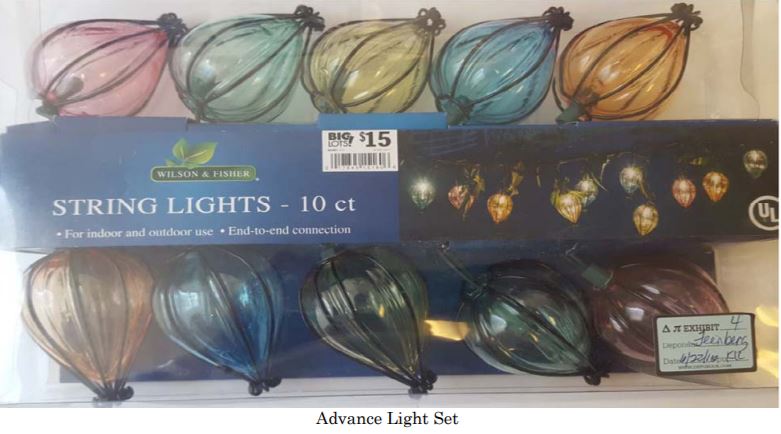
Cross-motions for SJ. Defendant raised issues as to Jetmax’ ownership of copyright. Also, it argued that the light set is not copyrightable because it is a useful article and because it lacks originality. The parties filed supplemental briefs after the SCOTUS issued its decision in Star Athletica v Varsity, 137 S. Ct. 1002 (2017).
Part One: Does Plaintiff Jetmax Own The Copyright?
In its copyright registration application, plaintiff Jetmax identified itself as the author.
In its complaint, Jetmax alleged that the Work was designed “by an employee of [plaintiff] in the scope of their employment as work for hire.”
In discovery, Jetmax disclosed that the designer was in fact paid by an intermediary company (“Intermediary”), because “under Chinese law, only Chinese entities are allowed to have employees in mainland China.”
We don’t know from the facts of the decision, the nature of ownership and control, if any, between Jetmax and Intermediary.
Under the Copyright Act, ‘employer’ and ‘author’ are not defined terms. Under case law, a Work is made at an employer’s ‘instance and expense’ – an employer induces creation and has the right to direct and supervise.
Here – at summary judgment, court notes that plaintiff’s discovery deposition ‘suggests that the design employees in mainland China were paid and employed by’ the Intermediary (as an aside plaintiff seems to have hurt itself (1) by not identifying the Intermediary in its initial disclosures and (2) because it ‘failed to sufficiently produce responsive documents concerning the Intermediary’).
For purposes of summary judgment, there were sufficient triable issues relating to the facts regarding plaintiff’s ownership, to deny summary judgment to plaintiff.
Quick Practice Pointers:
1. If a client said to you that the work was created by ‘its’ employee, now you know to dig deeper on that.
2. You can’t retroactively create a work made for hire, and not everything is eligible for the ‘independent contractor’ prong of the work made for hire provisions (industrial design products aren’t, for example). This is one more reason why agreements (such as those between an intermediary and an employer) should contain, in addition to clauses seeking to create a work made for hire relationship, back-up clauses that assign any and all rights, as well.
[embeddoc url=”https://www.schwimmerlegal.com/wp-content/uploads/sites/833/2017/09/JetmaxLtdBigLots20170828-1.pdf”]
. . . is too long.
monk's family sues over name/image used on brother thelonious belgian style abbey ale. cc @zahr_said & @linfordinfo https://t.co/3qgDzq4Jnp pic.twitter.com/JpGPVwYwSW
— alexandra j. roberts (@lexlanham) September 1, 2017
[Eugene Volokh] Pseudonymous litigation, and alleged skulduggery in the world of romance novelists https://t.co/vnWECyj6TA pic.twitter.com/L4ZqBo15ZB
— Volokh Conspiracy (@VolokhC) September 1, 2017
Only 16% of people correctly recall famous #logos https://t.co/GgXAxyFbmF #trademarks #iplaw #iprights #ipnews #branding #brandprotection
— Marksmen (@MarksmenTweets) September 1, 2017
Messed around and got a triple double https://t.co/PdbcNk66tH
— TrademarkBlog (@TrademarkBlog) September 1, 2017
BREAKING: Full en banc Federal Circuit will rehear case challenging USPTO's attorneys-fees-no-matter-what rule: pic.twitter.com/TzOaC8mijF
— Bill Donahue (@Bill__Donahue) August 31, 2017
TTAB Says LUXFORD is primarily merely a surname for plumbing products because there are people with that name. https://t.co/2B3KLNFF3L pic.twitter.com/4RHgzFlx9d
— TTABlog (@TTABlog) August 31, 2017
This case, American Cruise Line v HMS American SteamBoat Queen, seems to suggest that it can be. I believe there are other cases that suggest otherwise (GoPets v. Hise).
[embeddoc url=”https://www.schwimmerlegal.com/wp-content/uploads/sites/833/2017/08/AmericanCruiseLinesHMSAmericanQueenSteamboat20170816-1.pdf”]
TMView is a handy multi-country online trademark search tool provided by the good people at EUIPO, who, among other things, administer the European Community Trademark.
TMView is found at “tmdn.org”. If you search ‘TMView’, you will receive a result which may look like this:

HOWEVER, you may also receive an additional search result that looks like this:

If you click on that link you will be directed to a site at “tmview dot com” which will resemble Euipo’s TMView site. If you look carefully, you will see that it is not the real TMView site(for example, when I visited today, the news clippings are from 2015).
If you perform a trademark search on this page, you will not receive search results, but rather you will be directed to the official TMView search page. Most people will likely assume that there was some glitch, and start again.
I do not know precisely what occurs to search terms on the page.
However, based on similar pages in the past, I will speculate that what might be happening is that the site is saving and harvesting these search terms. If someone wanted to search a possible trademark such as [EXAMPLE] on TMView, they may not have yet used that term or filed a trademark application. The act of searching that term may be of interest to a domainer, who might be tempted to file for [EXAMPLE] in important TLDs.
The registrant of is ‘Institute of Advanced Networking Technologies’ to whom it was transferred by Michael Gleissner in 2015. The admin email addresses for both Mr. Gleissner and the present registrant, are hosted at bigfoot.com. Mr. Gleissner is the founder of Bigfoot Enterprises, according to this interesting WIPR article.
H/T John Berryhill.
Remember – these are allegations.
[embeddoc url=”https://www.schwimmerlegal.com/wp-content/uploads/sites/833/2017/08/Seth-Rich-Fox-News-1.pdf”]


DJ Plaintiff uses HIPPIE LAUNDRY for clothing. DJ Defendant owns CHINESE LAUNDRY and DIRTY LAUNDRY for shoes. Defendant protested Plaintiff’s potential expansion of HIPPIE LAUNDRY into footwear.
[embeddoc url=”https://www.schwimmerlegal.com/wp-content/uploads/sites/833/2017/07/laundry-trademark-complaint-1.pdf”]
TTAB Test: Is "ROSE" Generic for Beer-Based Mixed Beverages? https://t.co/wsgda041qT pic.twitter.com/yaXBK8BDAz
— TTABlog (@TTABlog) July 10, 2017
India:
Online infringement: the role of intermediarieshttps://t.co/kjdEDR1i8g— TrademarkBlog (@TrademarkBlog) July 10, 2017
interesting #trademark: configuration of bourbon bottle resembling shotgun shell with rattlesnake wrapping around ithttps://t.co/k29TlVVs5f pic.twitter.com/1S81LM9vw7
— Erik Pelton® (@tm4smallbiz) July 7, 2017
The Russian Supreme Court upheld a 'confusing IP Court decision that seems to collide with Russian legislation' https://t.co/pKhKt2d7S4
— TrademarkBlog (@TrademarkBlog) July 7, 2017
Moët Hennessy successful in #trademark infringement case over sale of counterfeit champagne by auction house. https://t.co/O3XeLOGo7o
— Lee Curtis (@BrandsAndStuff) July 7, 2017
a few misrepresentations aren't commercial advertising or promotion https://t.co/sGgmmOrWty
— Rebecca Tushnet (@rtushnet) July 5, 2017
[embeddoc url=”https://www.schwimmerlegal.com/wp-content/uploads/sites/833/2017/07/solmetex-sdny-false-advertising-1.pdf”]