From NY Times article on proposed tariffs:

Luxury Handbags

“Placing tariffs on products like ours (in particular handbags) that are not at risk for intellectual property theft in manufacturing, and are not related to the China 2025 plan, will only ennoble the bad actors in the Chinese economy who pose a genuine threat to our business via bad faith registrations of our recognized trademarks.”

— Written request to testify from Rebecca Minkoff

Chinese counterfeiting is a huge financial problem for luxury handbag, shoe and other retailers, who collectively lose billions of dollars each year as a result of knockoff versions of their products that are produced in China and sold globally. Companies say the tariffs will simply make their products more expensive to produce and give counterfeiters a bigger leg up in the marketplace.

….

Amicus Brief of Intellectual Property Owners Association, in support of neither party, drafted by my colleagues Rob Isackson, Matt Kaufman and Lauren Sabol.

ARGUMENT

I. Proper Application of the Post-AIA OnSale
Bar Is Critically Important to All
Industries and Fields of Technology

II. The Post-AIA On-Sale Bar Provision Should
Be Interpreted to Exclude Secret Sales

a. Statutory Construction Principles
Confirm That Congress Intended to Exclude Secret Sales from the
On-Sale Bar

b. The Legislative History of the AIA
Confirms That Secret Sales Were
Meant to Be Excluded

III. Excluding Secret Sales Is Consistent
with Congress’ Intent for the AIA to
Harmonize United States Patent Laws
with Other Countries

IV. The Fe der a l C i r c u it D e c i sion Is
Inconsistent with Other Interpretations
of the On-Sale Bar

a. The Federal Circuit’s En Banc
Decision in Medicines Compels a
Result That the Invention Was Not OnSale
in the Present Case

b. The Federal Circuit’s Decision Does
Not Square with Pfaff’s Requirement
That the Invention Be Public to Be
On Sale

c. The USPTO’s Post-AIA View of the
Scope of the On-Sale Bar Excludes
Secret Sales

d. The Concurrence Misapprehends
IPO’s Medicines Argument


[embeddoc url=”https://www.schwimmerlegal.com/wp-content/uploads/sites/833/2018/08/IPO-Amicus-Brief-in-Helsinn-Cert.-Granted_FILED-1.pdf”]

Reflex Media operates online dating websites such as SEEKING ARRANGEMENT.  Seeking Arrangement uses the term ‘Sugar Daddies’ to describe its target customers.  Its taglines RELATIONSHIPS ON YOUR TERMS and MUTUALLY BENEFICIAL RELATIONSHIPS are part of its coy branding.

Defendant RichMeetBeautiful (hmmm, a little too-on-the-nose) allegedly used plaintiff’s taglines, but also copied various profile descriptions.

[embeddoc url=”https://www.schwimmerlegal.com/wp-content/uploads/sites/833/2018/08/rich-meet-beautiful-complaint-1.pdf”]

Justia opinion summary:

The Ninth Circuit affirmed the district court’s grant of summary judgment for CoreLogic in an action brought under the Digital Millennium Copyright Act. Plaintiffs, professional real estate photographers, alleged that CoreLogic removed copyright management information from their photographs and distributed their photographs with the copyright management information removed, in violation of 17 U.S.C. 1202(b)(1)–(3).

The panel held that section 1202(b) requires an affirmative showing that the defendant knew the prohibited act would induce, enable, facilitate, or conceal infringement.

In this case, plaintiffs failed to make the required affirmative showing because they failed to produce evidence showing that CoreLogic knew its software carried even a substantial risk of inducing, enabling, facilitating, or concealing infringement, let alone a pattern or probability of such a connection to infringement.

The panel affirmed the district court’s denial of plaintiffs’ discovery request and the award of fees.

[embeddoc url=”https://www.schwimmerlegal.com/wp-content/uploads/sites/833/2018/08/corelogic-ninth-circuit-1.pdf”]

Daniel Wellington, which is the watch of the decade (para 11), sues Overstock for sale of counterfeit watches.  Screenshot above depicts top search results for “DANIEL WELLINGTON” on Overstock.com just now.

[embeddoc url=”https://www.schwimmerlegal.com/wp-content/uploads/sites/833/2018/08/Daniel-Wellington-watch-counterfeit-complaint-1.pdf”]

The ability to preserve food in cans had a profound effect on our diet and our economy.  For one thing, it gave birth to the can-opener industry.  Also, it provided variety to our diet, and, in the belief of the founder of Borden’s, helped mitigate cannibalism.

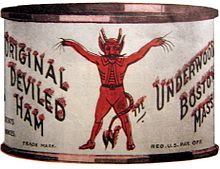
Nicholas Appert, a French national, developed a process for vacuum-packed hermetically sealed jars for food, by 1809 (an Appert Canning jar above).  This is a logo mark registered by the Underwood company to commemorate him.

Alpert’s method was kept a secret, however by 1830, William Underwood had duplicated the technique, and switched from glass jars to tin cans.  He obtained what some claim is the first U.S. registered trademark for deviled ham.

and looks like this today:


This is one registered version of the early design:


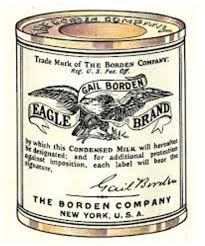
Gail Borden was another early entrepreneur in canned food.  Reportedly shocked by the cannibalism in the Donner Party disaster of 1846, he set about developing methods of condensing food.  And so he developed condensed milk, which was patented in 1856.  Here is an early logo:

which you can still buy:


The Civil War provided a market for canned food.  Joining these pioneers were Van Camp, which, before it sold Gatorade, sold pork and beans.


It also branched into canned tuna:


And providing the ready-made sauce for these canned foods was Lea & Perrins:

And for the do-it-yourself crowd, the Mason Jar was invented in 1859 by John Landis Mason.  However the best known trademark in Mason Jars today is Ball:

.

This blog post is a work in progress, and was inspired by The Rise and Fall of American Growth by Robert J. Gordon


Marcel and Lucky litigated use of the GET LUCKY and LUCKY marks three times.  The first lawsuit, in 2001, resulted in a release.  The second lawsuit, in 2005, revealed in early motion practice that the parties disagreed as to the scope of the release.  However, Lucky did not assert its interpretation of the release as a defense at trial. Now, in the third lawsuit, Lucky asserts its interpretation of the release.

The issue for the Second Circuit is whether claim preclusion encompasses defense preclusion, and if so, is Lucky precluded here from asserting a defense relating to the release, which defense it could have asserted in the 2005 lawsuit, but did not.

As to whether claim preclusion can prohibit defenses:

We are aware of no authority unequivocally prohibiting defenses from being
subject to the principle of claim preclusion.    Lucky Brand, in essence
acknowledging this dearth of authority, depends almost entirely on language from
a leading treatise, Br. of Appellees at 38, which indicates that “[i]t is generally
assumed that the defendant may raise defenses in the second action that were not
raised in the first, even though they were equally available and relevant in both
actions.”    Wright & Miller, 18 Fed. Prac. & Proc. Juris. § 4414 (3d ed. 2018)
[hereinafter, “Wright & Miller”].  But, Wright & Miller speaks only of a “general
rule” that departs from the standard we identified in Clarke.  Id.  Moreover, Wright
& Miller acknowledges that, in certain circumstances, “[d]efendant preclusion
should be seriously considered,” and that perhaps the “best rule” would at times
allow for the preclusion of defenses that could have been previously asserted.  Id

Noting that issue preclusion can be deployed both offensively and defensively, the Court observed that the same arguments in favor of offensive and defensive use of issue preclusion (namely, judicial economy arguments), apply to claim preclusion as well.  Thus, claim preclusion will act to bar asserting defenses that could have been asserted by a defendant against this plaintiff, previously.

[embeddoc url=”https://www.schwimmerlegal.com/wp-content/uploads/sites/833/2018/08/marcel-lucky-brand-1-1.pdf”]

Pinduoduo is an online shopping platform from China, that combines several e-commerce techniques, including coupons, and discounts for ‘aggregated sales’ (similar to the model of  Massdrop).  Pinduoduo is backed by Tencent.

It filed a Form F-1 in connection with a U.S. IPO on July 16.

On July 19, a Chinese diaper company, Beijing’s Daddy Choice, sued Pinduoduo, in the Southern District of NY, alleging that infringing goods were sold on the platform, with hte knowledge of Pinduopduo (complaint and blog post here).

On July 25, Pinduoduo raised $1.6 billion in its IPO, which values the company at $29.6 billion.  Shares traded as high as $27.54 on July 26.

On July 31, the Chinese State Administration for Market Regulation announced that it was investigating Pinduopduo over the reports of infringing goods being sold on the platform.

Yesterday, August 1, the price fell as low as $19.28.

By the end of yesterday,  securities lawyers were soliciting  Pinduoduo investors in connection with ‘possible violations of federal securities laws.’


Justia Summary:

OBC appealed the district court’s grant of summary judgment for Excelled in a trademark dispute over use of the brand-name ROGUE on t-shirts. The Second Circuit held that Excelled failed to show entitlement to summary judgment dismissing OBC’s trademark infringement counterclaims. In this case, Excelled failed to meet its burden of proving that OBC’s delay in bringing suit was unreasonable and caused prejudice to Excelled. Therefore, the court vacated the district court’s grant of summary judgment to Excelled, dismissing OBC’s counterclaims, alleging trademark infringement, false designation, and unfair competition. The court reversed the district court’s grant of summary judgment to Excelled on its infringement claims and the district court’s denial of OBC’s motion for summary judgment dismissing these claims. The court also reversed the award of injunctive relief and damages and fees against OBC. Finally, the court vacated the district court’s grant of summary judgment to Excelled on OBC’s trademark cancellation counterclaim because the district court erroneously relied on determinations of disputed facts about the continuity of Excelled’s sales that usurped the province of the jury.

[embeddoc url=”https://www.schwimmerlegal.com/wp-content/uploads/sites/833/2018/07/excelled-1.pdf”]

[embeddoc url=”https://www.schwimmerlegal.com/wp-content/uploads/sites/833/2018/07/excelled-1.pdf”]